




Built for life beyond the grid.
Industrial & Marine DC-DC Converters & Chargers
Explore our current converters and chargers. Compare the details and find the right model.
Explore the range12 V, 24 V or 48 V. Find your fit.
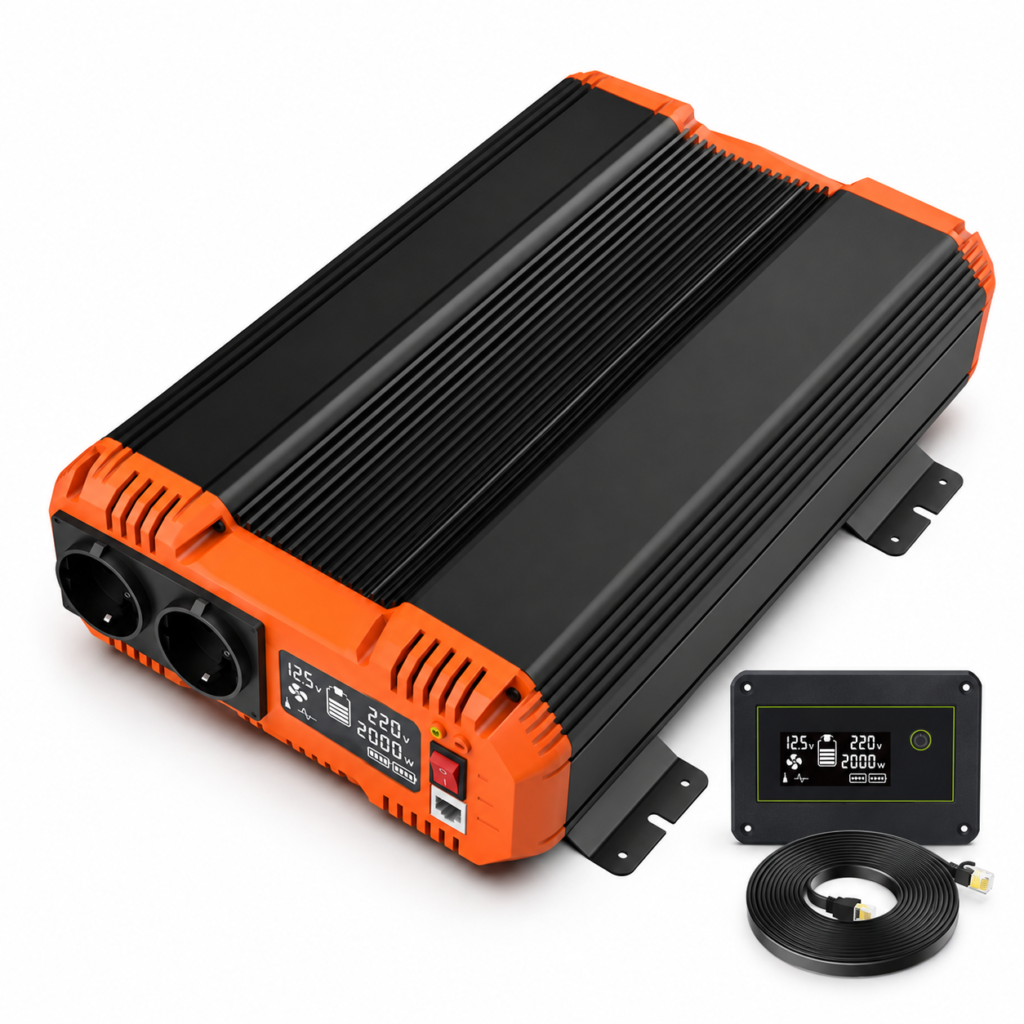
Pure Sine Inverter, 2500–3000W, 12/24/48V DC → 230V AC↗
Find your power
Choose your input voltage
01 — Made for your setup
Shop by category
Built around the details
Compare the details. Choose with confidence.
Compare input range, output voltage, current and power. Select a model to see its documented specifications.
Read the guideTechnical specifications↗
Input voltageV DC / V AC
Output voltageV
Output currentA
Output powerW
Efficiency%
The numbers that matter. In one place.
02 — Explore the range
Selected for your next build

Inverters
Pure Sine Inverter, 2000W, 12V DC → 230V AC, Display Included
From €219.06View product
Quick add

DC–DC chargers / converters
10–23V to 19/24/28V DC-DC Converter, 5–10A
From €9.24View product
Quick add

DC–DC chargers / converters
36/48V to 5V DC-DC Step-Down Converter, 20A
From €9.24View product
Quick addSelect a model for its exact specifications and available technical documentation.
Clear specifications
Understand the limits, not just the headline numbers.
Voltage options
Choose components around your system.
Europe in mind
Six languages. One straightforward store.
How do I choose between 12 V, 24 V and 48 V?+
Start with the voltage of your existing system. Your battery, inverter and charger must be compatible. A higher system voltage can reduce current for the same power, but every component must be sized together.
What does a BMS current rating mean?+
A battery management system monitors and protects the battery. Its current rating is a limit, not a promise of usable output. Check the battery’s continuous discharge, charging limits and temperature limits together.
Why does inverter idle draw matter?+
An inverter can consume energy even when no appliance is running. Compare idle consumption in watts alongside efficiency at your expected load.
Can I order from this store yet?+
Choose an available model and add it to your cart. Delivery and payment options are confirmed at checkout for your destination.
Learn
Technical guides
Plain-language guides to sizing, wiring and charging your power system.
- What is a DC-DC converter? Buck, boost and buck-boostA DC-DC converter turns one DC voltage into another without wasting the difference as heat. Buck, boost and buck-boost types and uses explained.
- How to size a LiFePO4 battery bank: Ah, Wh and runtimeWork out daily watt-hours, add inverter losses and days of autonomy, then convert to amp-hours at 12 V, 24 V or 48 V.
- 12 V, 24 V or 48 V battery system: which to choose?Pick a system voltage by inverter size, cable length and the equipment you own, with current and cable loss worked out for 12 V, 24 V and 48 V.
- Charging LiFePO4 from your alternator: a practical guideA converter holds a voltage; a charger controls current and voltage. What to check before charging a lithium bank from an alternator, and how to pick…
- MPPT vs PWM solar charge controllers: which one do you need?How PWM and MPPT solar charge controllers differ, how to size the current and voltage limits, and which settings a LiFePO4 battery needs.
- Why DC-DC converter efficiency matters (and what 95% really means)Efficiency decides how much of your power becomes heat. Here is how to read the documented figures, why fanless high-power converters are possible, an…